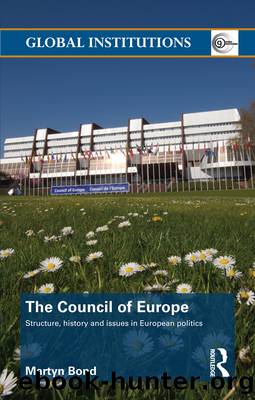
The Council of Europe: Structure, History and Issues in European Politics by Martyn Bond
Author:Martyn Bond [Bond, Martyn]
Language: eng
Format: epub
Tags: International Relations, General, Political Science, NGOs (Non-Governmental Organizations), Treaties
ISBN: 9781136588051
Google: aOvFBQAAQBAJ
Goodreads: 17547581
Publisher: Routledge
Published: 2011-12-01T00:00:00+00:00
7 The wilderness years
⢠Superpower rivalry in Europe
⢠Internal dissent and social unrest
⢠Conventions on extradition and the suppression of terrorism
⢠Military coups in Greece and Turkey
⢠Small steps
⢠The embryonic European Union
⢠Local democracy and civil society
⢠Conclusions
The next two decades of the Council of Europeâs historyâfrom the early 1960s to the late 1980sâpresent a picture of uncertainty and muddle. These were difficult years for divided Europe, caught in the field of tension between the United States and Russia, perhaps the coldest years of the Cold War. They were the years between the building of the Berlin Wall, erected in 1961, and its fall in 1989. Outflanked by the expanding responsibilities and the growing membership of the European Economic Community and overshadowed by superpower rivalry that froze the borders between East and West, the CoE seemed to have lost its way, failing to rise to the challenge of the times. They were wilderness years for the CoE.1
Superpower rivalry in Europe
In this period the military confrontation between the North Atlantic Treaty Organization (NATO) and the Warsaw Pact dominated the political landscape in Europe. The border between the two sides was fixed and fortified. Contact was sparse and trade was severely restricted. Only the desperate or the foolhardy tried, often at risk of their lives, to escape from the totalitarian societies of the East to live in the free West.
The superpowers devoted enormous resources to armaments, emphasizing the nuclear threat that they posed to each other while maintaining millions of men under arms in Europe on each side of the East-West divide. Proxy wars multiplied in other parts of the world, probing for weaknesses on either side and testing the limits. Within this framework of armed stand-off, of deterrence through the doctrine of mutual assured destruction (MAD), even revolutionary events, which temporarily shook the European states involved, failed to loosen the ideological and above all the security grip that held the system firmly in place.
In 1953 a workers protest turned into a widespread revolt across East Germany, but was put down by the Soviet forces after five days of bloodshed. In 1956 the Hungarian Uprising was brutally suppressed by the Soviet army, leading to an exodus of more than a quarter of a million refugees across the border into Austria. In 1968 the Prague Spring, led by a reforming communist leader, Alexander DubÄek, gave Czechs and Slovaks a few monthsâ taste of relative liberty before it, too, was bloodily suppressed by Warsaw Pact forces. Repression on this scale and of this nature deepened the divide in Europe. It was certainly not conducive to rapprochement across the East-West divide.
The ebullient and sometimes erratic Nikita Khrushchev ruled Russia as Secretary General of the Communist Party from Stalinâs death in 1953 until 1964, threatening on one occasion to âburyâ the West. Soviet government then passed into the iron but aging grip of Leonid Brezhnev who maintained his long, conservative reign from 1964 to 1982. After him in quick succession came two former heads of
Download
This site does not store any files on its server. We only index and link to content provided by other sites. Please contact the content providers to delete copyright contents if any and email us, we'll remove relevant links or contents immediately.
| Anthropology | Archaeology |
| Philosophy | Politics & Government |
| Social Sciences | Sociology |
| Women's Studies |
The Secret History by Donna Tartt(19066)
The Social Justice Warrior Handbook by Lisa De Pasquale(12190)
Thirteen Reasons Why by Jay Asher(8897)
This Is How You Lose Her by Junot Diaz(6881)
Weapons of Math Destruction by Cathy O'Neil(6270)
Zero to One by Peter Thiel(5793)
Beartown by Fredrik Backman(5744)
The Myth of the Strong Leader by Archie Brown(5505)
The Fire Next Time by James Baldwin(5434)
How Democracies Die by Steven Levitsky & Daniel Ziblatt(5217)
Promise Me, Dad by Joe Biden(5148)
Stone's Rules by Roger Stone(5085)
A Higher Loyalty: Truth, Lies, and Leadership by James Comey(4958)
100 Deadly Skills by Clint Emerson(4922)
Rise and Kill First by Ronen Bergman(4784)
Secrecy World by Jake Bernstein(4746)
The David Icke Guide to the Global Conspiracy (and how to end it) by David Icke(4712)
The Farm by Tom Rob Smith(4505)
The Doomsday Machine by Daniel Ellsberg(4489)
